
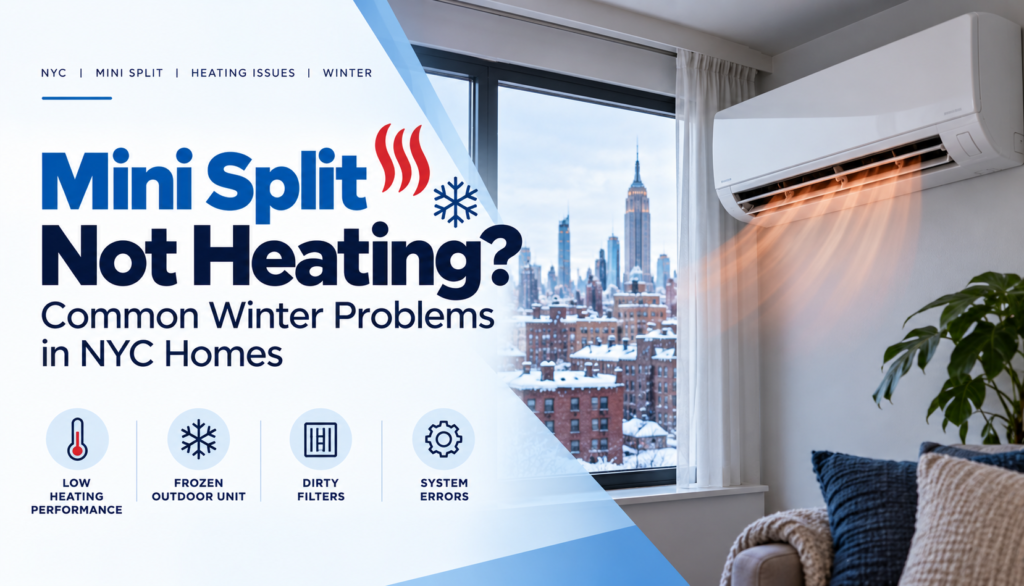
When temperatures drop across the five boroughs, a mini split not heating is one of the most common service calls New York HVAC contractors receive. Ductless mini split systems have become the go-to heating and cooling solution for NYC apartments, brownstones, and co-ops that lack traditional ductwork, but the same features that make them efficient also make them sensitive to a handful of predictable winter problems.
If your ductless mini split is blowing cold air, cycling on and off, or refusing to turn on at all, the cause is rarely a mystery once you know what to look for. This guide walks through the most common reasons a mini split stops heating in NYC winters, what is specific to New York City buildings, and when it makes sense to call a professional instead of troubleshooting on your own.
Table of Contents
Why Mini Splits Struggle More in NYC Winters
NYC housing stock creates conditions many mini split manufacturers never designed around. Pre-war buildings and high-rise co-ops often run older single-phase electrical panels not built for a dedicated heat pump circuit, making tripped breakers more common here than in newer suburban construction.
Rooftop and terrace-mounted outdoor units in Manhattan and Brooklyn also face constant wind exposure and limited clearance from parapet walls and neighboring equipment. That crowding restricts airflow around the outdoor coil, the exact component a mini split heat pump relies on to extract heat from cold outside air.
Common Winter Problems That Cause a Mini Split Not to Heat
1. Wrong Mode Setting
The single most common reason a mini split is not heating has nothing to do with mechanical failure. Many remotes default to Auto or Cool after a power blip, and the system will not produce warm air until it is manually switched to Heat mode with the temperature set several degrees above the current room reading.
Fan Only and Dry modes are also frequently confused with Heat mode on universal remotes, since both circulate air without warming it. Before assuming the worst, confirm the sun or flame icon is selected and give the unit five to ten minutes to begin producing warm airflow.
2. Normal Defrost Cycle Mistaken for a Malfunction
Ductless heat pumps pull warmth from outdoor air even in freezing temperatures, which means frost naturally builds on the outdoor coil during humid NYC winter days. The system periodically reverses itself into a short defrost cycle to melt that frost, during which the indoor fan pauses and steam may appear near the outdoor unit.
A defrost cycle lasting five to fifteen minutes is completely normal winter operation, not a sign your mini split is broken. If defrost cycles run longer than fifteen minutes, happen every hour, or leave a heavy layer of ice behind, that pattern usually points to a refrigerant or sensor issue rather than routine defrosting.
3. Dirty or Clogged Air Filters
NYC apartments accumulate dust, cooking residue, and city air pollution faster than suburban homes, and mini split filters clog accordingly. A restricted filter starves the indoor coil of airflow, which can make the unit blow lukewarm or weak heat even when every other component is functioning correctly.
Most manufacturers recommend cleaning mini split filters every two to four weeks during heavy winter use. This is one of the few fixes homeowners can safely handle without a technician, and it resolves a surprising share of “mini split not heating” service calls before a truck ever needs to roll.
4. Blocked or Iced-Over Outdoor Unit
Snow drifts, ice buildup, and debris blown between buildings can physically block the outdoor unit’s coil and fan, especially in tight NYC side yards and rooftop installations. Once airflow is cut off, the system cannot extract enough outdoor heat to warm your apartment regardless of the indoor settings.
Outdoor units need roughly twelve to eighteen inches of clearance on all sides and should sit elevated above expected snow accumulation. Light frost is normal, but thick ice encasing the cabinet or fan blades should be cleared carefully with lukewarm water rather than a heat gun or sharp tool, which can damage the coil fins.
5. Tripped Breaker or Power Loss
Mini splits run on a dedicated circuit, and older NYC electrical panels are more prone to nuisance trips during cold snaps when heating demand spikes citywide. A tripped breaker or blown fuse will cut power to the outdoor unit while sometimes leaving the indoor head partially lit, which can look like a smaller malfunction than it actually is.
Check the panel for a breaker labeled Heat Pump or Mini Split, reset it fully to off and then back to on, and confirm the outdoor unit fan starts spinning. If the breaker trips again immediately, stop resetting it and call an electrician or HVAC technician, since repeated trips usually signal a wiring or component fault.
6. Low Refrigerant Levels
Refrigerant is what actually carries heat from the outside air into your home, and even a small leak reduces a mini split’s heating capacity noticeably once temperatures drop. Systems low on refrigerant often blow air that feels cool rather than warm, and ice may form on the indoor unit even while it appears to be running normally.
Refrigerant work requires EPA 608 certification, so this is not a homeowner fix under any circumstances. If filters are clean, the mode is correct, and the outdoor unit is clear but heat still is not improving, a licensed technician should pressure-test the lines for leaks.
7. Thermostat or Sensor Malfunction
Wall-mounted mini split heads rely on internal sensors to judge room temperature, and a miscalibrated or failing sensor can tell the system the room is already warm enough when it is not. This is especially common in older units or after a power surge, which can knock sensors out of calibration.
If the display temperature does not match what a separate thermometer reads in the same room, or the unit short-cycles on and off without reaching the setpoint, a sensor issue is likely. Technicians can typically test and replace these sensors without needing to replace the entire indoor unit.
8. Incorrect System Sizing for the Space
A mini split undersized for a large NYC loft or open-concept renovation will run constantly without ever catching up to the thermostat setting. An oversized unit in a small studio, by contrast, can short-cycle on and off before it properly warms the room.
Sizing mistakes are common in older installations that predate a renovation or added square footage. If your unit runs nonstop all winter and still cannot maintain temperature, a load calculation from a licensed installer can confirm whether it was ever correctly matched to the space.
9. Aging or Worn Reversing Valve
The reversing valve switches a mini split heat pump between cooling and heating modes, and it wears out over years of seasonal cycling. When it fails, the unit may get stuck in cooling mode with Heat selected, or cycle erratically between hot and cold air.
This is a mechanical failure rather than a settings issue, typically showing up in systems eight to twelve years old or lacking regular maintenance. Reversing valve repairs require a certified technician, since the fix involves refrigerant recovery and internal component replacement.
NYC-Specific Factors Worth Knowing
Co-op and condo boards across Manhattan and Brooklyn frequently restrict where an outdoor condenser can be mounted, sometimes forcing installers into locations with less-than-ideal airflow. If your board recently changed exterior equipment rules, confirm your unit’s placement still meets current guidelines.
Older brownstones also tend to have thinner exterior walls and less insulation around line-set penetrations, letting cold air infiltrate around the wall sleeve and reducing effective heating output. Sealing and insulating around the line set is a low-cost fix that noticeably improves winter performance in these buildings.
When to Call a Professional
Simple checks like switching to Heat mode, cleaning the filter, clearing outdoor debris, and resetting a tripped breaker are safe for any homeowner to try first. If the system still is not heating after these steps, or if you notice burning smells, oil residue near the refrigerant lines, or a breaker that trips repeatedly, stop troubleshooting and call a licensed HVAC technician.
Flow HVAC NYC provides same-day mini split repair and installation across all five boroughs, with technicians who are familiar with the electrical and structural quirks of NYC buildings specifically. A seasonal maintenance plan also catches most of the issues above before they turn into a mid-winter breakdown.
Preventing Mini Split Heating Failures Before Winter
A pre-season tune-up is the most reliable way to avoid a no-heat emergency in January. Technicians clean coils and filters, check refrigerant charge, inspect electrical connections, and confirm the outdoor unit has proper clearance before the cold weather arrives.
Many NYC property owners bundle this with a broader HVAC checkup, particularly buildings that also run PTAC units or fan coil systems alongside mini splits. Property managers overseeing multiple units across Manhattan, Brooklyn, or Queens buildings tend to see the biggest drop in emergency winter calls once a maintenance plan is in place.
Frequently Asked Questions
Why is my mini split blowing cold air instead of heat?
This usually means the system is in the wrong mode, mid-defrost cycle, low on refrigerant, or has a blocked outdoor unit. Check the mode setting and outdoor unit clearance first before assuming a mechanical failure.
How long should a mini split defrost cycle last in winter?
A normal defrost cycle lasts between five and fifteen minutes. Cycles that run longer or happen more than once an hour usually indicate a refrigerant or sensor problem that needs professional diagnosis.
Can cold NYC winters be too extreme for a mini split to heat effectively?
Most modern cold-climate mini splits heat efficiently well below freezing, but capacity naturally decreases as outdoor temperatures drop. If your unit struggles below a specific outdoor temperature, it may not be rated for cold-climate performance.
Is a mini split not heating an emergency in winter?
It depends on the building and the occupants. If it is the sole heat source for the space and outdoor temperatures are dangerously low, treat it as urgent and request same-day service rather than waiting.
Do NYC electrical panels cause more mini split heating problems?
Older single-phase panels common in pre-war NYC buildings are more prone to nuisance breaker trips during high winter demand than newer residential panels. A licensed electrician can confirm whether your panel has adequate dedicated capacity for a mini split heat pump.
Get Your Mini Split Heating Again
A mini split not heating during an NYC winter is inconvenient, but most causes are identifiable within a single visit from an experienced technician. Flow HVAC NYC offers same-day mini split repair across Manhattan, Brooklyn, Queens, the Bronx, and Staten Island, with technicians who understand the specific electrical and structural challenges of NYC buildings.
If troubleshooting the mode, filter, and outdoor unit does not restore heat, contact Flow HVAC NYC or call (212) 731-8383 for same-day diagnosis and repair before the next cold snap.